
A graduate freezes on a basic engineering question in a job interview. This post uses Nolan Lovett's research to explain why - AI can quietly strip out the judgement-building work graduates need, even while output and headcount keep rising. It ends with concrete steps a practice can take to keep training real.
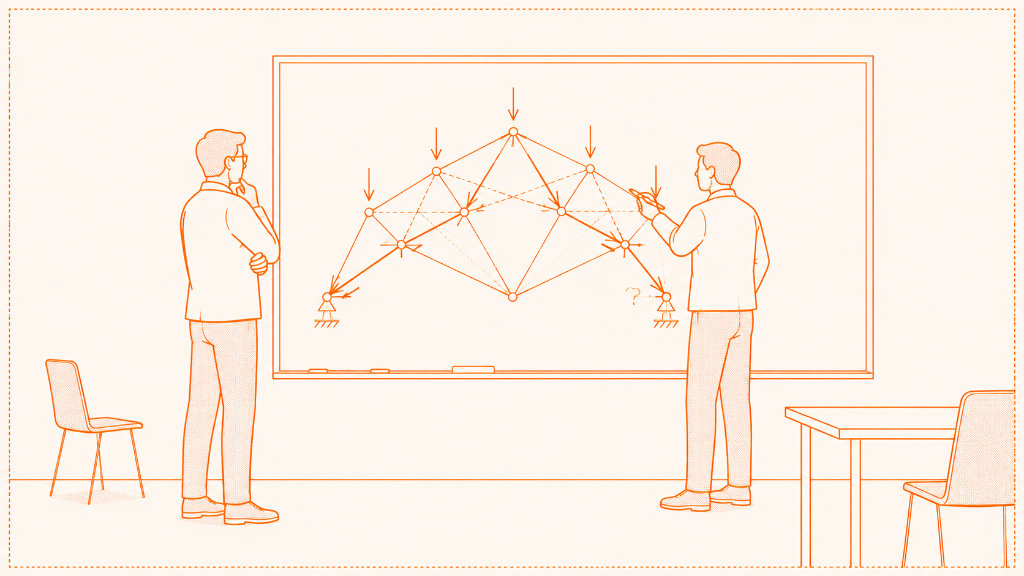
In a job interview, a director draws a space frame on the whiteboard and asks where the load goes.
The candidate has four years experience after graduating. Good CV, real projects, fluent about all of them. He takes a run at the question. It's... fine. He's not obviously wrong. Just strangely lightweight. He can trace the load path, but he struggles when the question shifts from what happens to why it happens or how you'd improve it. You get the sense that he's seen the answers many times without ever having had to discover them for himself.
In that four years, he worked on real buildings, shipped real drawings, had his work checked by people who knew what they were doing. But what he built in that time was fluency at running the tools that produced the answers, not a deep understanding of the underlying theory.
Nobody did anything wrong. His previous firm made sensible calls about getting work out of the door. His supervisors signed off work that was correct. The technical expertise that he was supposed to be gaining was being bypassed, one convenient task at a time, and the first person to notice was a stranger with a whiteboard marker.
Nolan Lovett published a paper about this, in Human Resource Development Review. He separates internalised mastery from distributed mastery:
What connects them is the validation tether. Distributed mastery stays safe only while internalised mastery sits underneath it, because deep knowledge is what catches output that appears correct but is actually wrong.
Lovett's model deals with checking too. Surface validation asks whether the output is consistent, formatted, plausible. Many people can do that. Substantive validation asks whether it is correct: this superstructure, these ground conditions, this client, this fabricator's standard connections. Only deep domain knowledge can achieve that, and a consultancy practice that measures output volume may see the difference between the two.
Lovett identifies two failure modes relevant to professional consultancy:
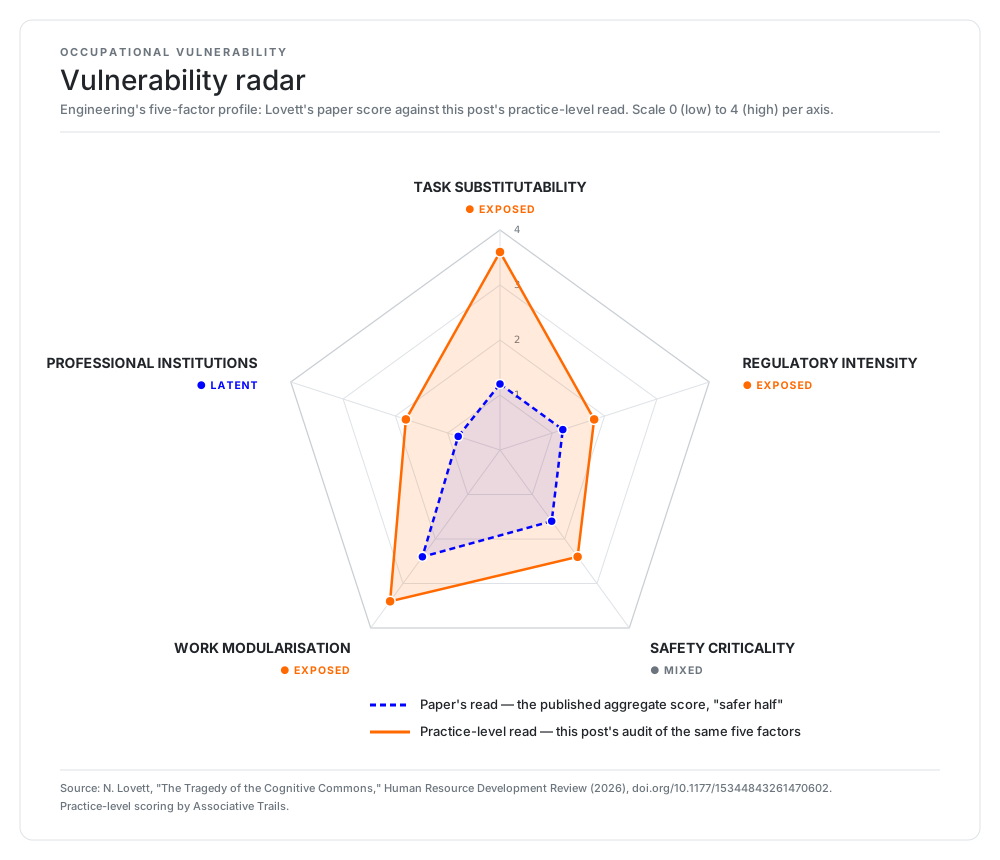
He also scores occupational vulnerability across a number of factors and puts engineering consultancy in the safer half.
Maybe this concern turns out to be overstated. The recent evidence is actually quite encouraging. Ramp's economists looked at roughly 22,000 US firms and found the heaviest AI spenders grew white-collar headcount 10.2% over two years, entry-level hiring rising faster still. Anders Humlum and Emilie Vestergaard found near-zero effects on Danish earnings and hours in the first two years of chatbot adoption. Lovett does say that the depletion mechanism is not universal and that the tragedy has not arrived.
But none of that deals with degradation in internalised mastery and substantive validation skills. A firm could double graduate recruitment while quietly reducing the amount of work that develops deep understanding. Hiring more graduates does nothing if they spend three years becoming very good at using AI without becoming equally good at the underlying discipline. Headcount can keep growing and there still be a decay in deep domain knowledge, and the current evidence measures only the first.
This feels more manageable if you frame it as a training problem instead of an AI problem.
Start by auditing what you are currently handing off to AI. For each task, ask what a graduate learned when they had to do it. Did these reps add to their deep domain knowledge? Where the answer is yes, you may have reduced a cost in the short term, but stored up a real problem for the future.
A few practical habits seem worthwhile, when handing something off to AI:
Lovett's paper is conceptual and does not reflect the recruitment numbers holding firm in recent surveys. Professional expertise is not about to collapse.
What it gives us is a vocabulary for discussing the effect AI is having on professional workplaces and occupational vulnerability - a language for describing a risk that many people seem to recognise intuitively but struggle to explain. Before it, a director had an anecdote about one weak candidate in an interview. After it, they have something they can identify, monitor, and mitigate. The question isn't whether AI can carry the load. It's whether you've made sure it's carrying the right load.
If you would like to find out more about working effectively with AI, please do get in touch.