
Two studies published three days apart, the ONS's UK business survey and Google's ATLAS report on Gemini usage, show AI reaching most firms while changing very little inside them. Adoption has been broad but shallow, driven by individuals rather than any strategic redesign. The real question is not whether a firm uses AI, but who chose the work it touches.
On 20 July the ONS published Artificial intelligence in UK businesses: 2023 to 2026, drawn from 38,637 responding businesses surveyed between 5 and 28 June. On 23 July Google and Google DeepMind published AI & Economy ATLAS v1.0, drawn from 14,653,926 de-identified Gemini interactions sampled between 6 and 19 April.
They measure different populations in different ways, so the numbers should not be treated as directly comparable. One is a survey of British businesses. The other is based on millions of (mostly American) conversations with Google Gemini. One relies on what firms say they do, the other observes what individuals actually type into an AI chatbot.
Even so, the shape is difficult to ignore. AI has spread widely and shallowly, and in most organisations nobody chose which work it would touch.
By either measure, AI is no longer a niche technology.
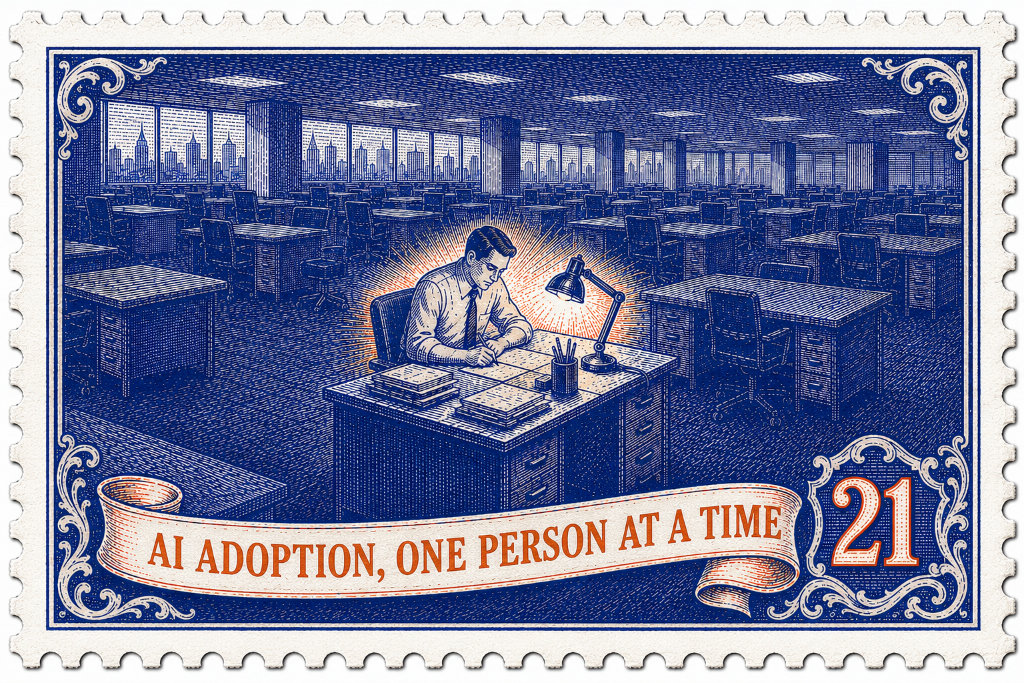
What determined that 21%? The answer seems to be less strategic than firms might like to admit. AI has entered organisations through individuals, not company-wide initiatives.
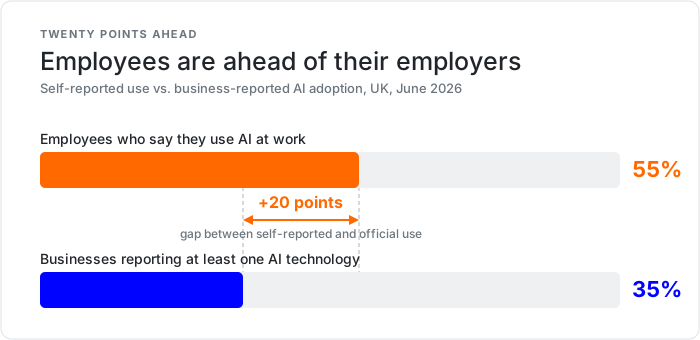
So one of the largest studies of AI's relationship with work is mostly observing people using a consumer tool outside formal company systems. Meanwhile, the national business survey suggests that many employees are already using AI before their employers realise.
Perhaps that is how adoption really happened. Not through a board decision or a redesigned process, but through someone opening a browser and pasting in a task they need help with.
Individual experimentation is quick, cheap, and further along than most firms assume. A graduate can reconcile two schedule exports with a script they wrote that morning, run a parametric study that used to take a week, produce a first-draft clash report, alone and without asking. The ceiling on solo work sits well above email-rewriting. But it is still a ceiling. What a person cannot do alone is give the AI the history of a client relationship, the precedent behind a decision, or the reason a particular project methodology failed in 2022. They also cannot procure the tool, agree a data retention policy, or keep client-confidential material inside a boundary the firm controls. This is not just experimentation around the edges. Employees are doing substantial work with tools the firm may not know about.
Perhaps 21% is not a capability ceiling at all. Maybe it is the limit of what one employee can safely do without the organisation noticing.
“
“Perhaps 21% is not a capability ceiling at all. Maybe it is the limit of what one employee can safely do without the organisation noticing.”
Two ATLAS findings make the pattern stranger:
The highest-paid people appear to be using AI most heavily on the least expert parts of their jobs. At an individual level, this makes sense. Saving a senior employee twenty minutes of rewriting has value. But it is not the same as changing how the firm works.
Firms often describe this as a skills problem. Staff need training. They need to understand the tools, learn better prompting and become more confident.
The ONS shows businesses responding accordingly. Among firms citing a lack of AI expertise as a barrier, around 62% are training or retraining existing staff, compared with around 26% of businesses reporting no barriers. Only 11% say more than half their workforce has received AI-related training.
Training is the obvious response. It may also be the wrong place to start. Many employees are already reasonably fluent - they have practised at home, where most observed usage still takes place. What they cannot do alone is provide the background that depends on the firm's accumulated memory: the precedent, the project history, the client context and the reasoning behind previous decisions.
The missing piece is not staff skills. It is the written context that would give that skill something more valuable to work on.
“
“The missing piece is not staff skills. It is the written context that would give that skill something more valuable to work on.”
This is why “Are you using AI?” has become a dead question. A firm can answer yes because a few employees use ChatGPT to draft emails. Another can answer yes because AI is designed into a core client process. The same tick box covers both.
A better question is: which fifth of your employee's work does AI already touch, and who chose that fifth?
In many firms, nobody chose it. Not the managing partner, not IT and not whoever signed off the software licences. It was added one person at a time. Employees chose work that was easy to isolate, explain and do alone. Anything requiring shared context or permission stayed untouched. Unfortunately, that may also be where most of the value sits.
Around half of firms tell the ONS that AI has made no difference to headcount. That can be read as reassuring. It may also explain why nobody feels much urgency to look more closely.
AI has arrived almost everywhere - it helps with fragments of work and nothing important appears to have broken. That looks like successful adoption. Or it may be what happens when everyone starts using a new technology on a piecemeal basis, with nobody designing the overall process.
(1) ATLAS counts a task as covered where at least 25 unique users globally were observed performing it. Rare tasks in small occupations are therefore invisible, so 21% is a floor.
❝
“Our plans go astray because they have nothing to be directed toward; for the man who does not know which harbor he is making for, no wind is favorable.”
If you would like to find out more about working effectively with AI, please do get in touch.